How to hang a picture, at the right height and on the right fixing
How to hang a picture comes down to two decisions and one measurement. The decisions are how high and what fixing; the measurement is the one almost everybody gets wrong, because they measure to the hook rather than to the middle of the picture.
A print leaning against a baseboard for eight months is not a decision, it is a fixing you did not have. What follows is the short version: where to put it, what to put it on, and how to avoid the row of exploratory holes.
How to hang a picture at the right height: measure to the middle
The convention in galleries is to hang so the centre of the picture sits at eye level, which is usually taken as somewhere around 145 to 150 cm from the floor. That is a convention rather than a law, and it exists because it is roughly the eye height of a standing adult.
The practical method: find the centre height you want, measure from the top of the frame down to the taut hanging wire or the back of the fixing, and subtract. That gives you where the hook goes. Measuring straight to the hook is what puts pictures thirty centimetres too high, which is the single most common fault in a room.
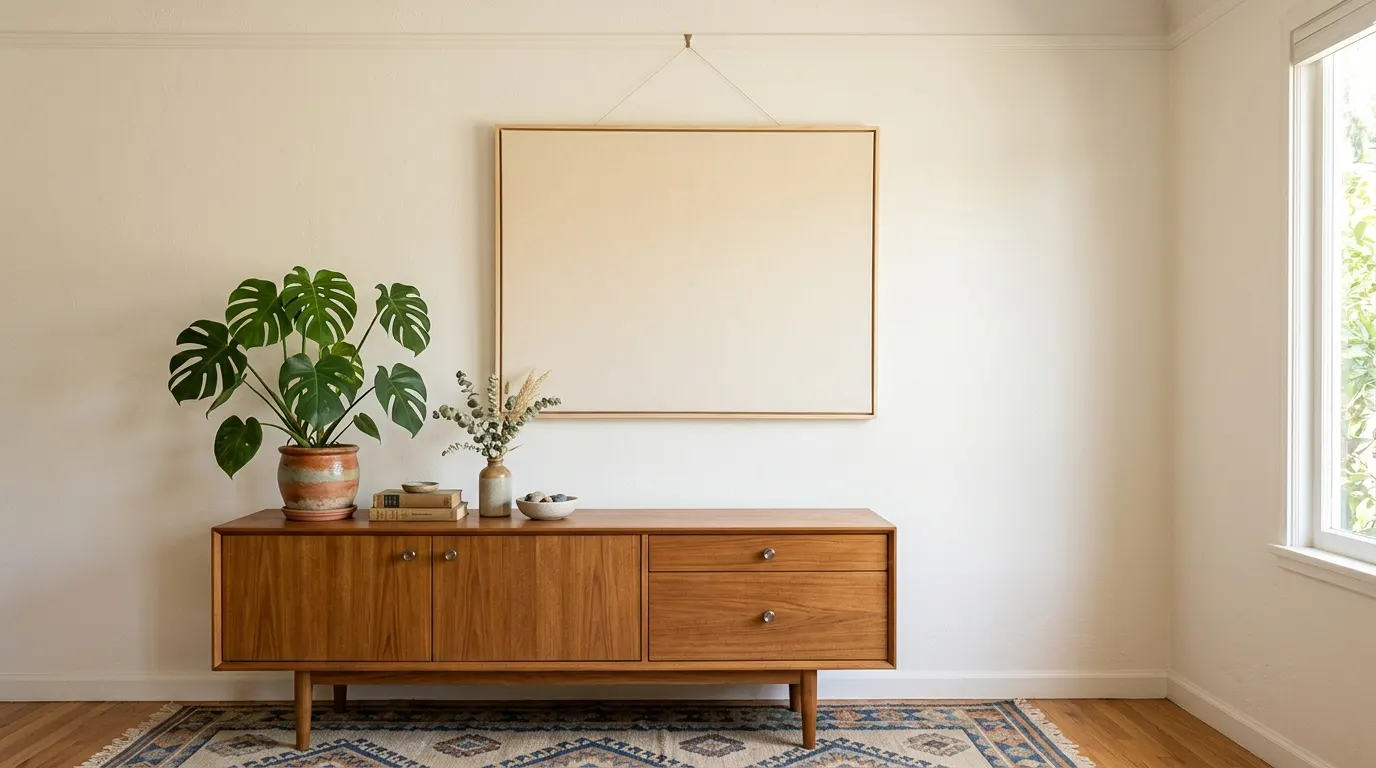
Two exceptions worth making. Above a sofa or a desk, hang lower - relate it to the furniture rather than to the room, with a hand's width or so of gap. And if the room is mostly used sitting down, drop the whole thing a little.
Find out what your wall is first
Knock it. A solid, dull sound is masonry or solid plaster; a hollow one is plasterboard with a void behind. The fixing depends on the answer more than on anything else, and getting it wrong is what turns one hole into five.
- Plasterboard, light picture. A picture hook with hardened pins will hold a poster or a small frame perfectly well and leaves pinholes rather than a crater.
- Plasterboard, anything heavier. Use a proper plasterboard fixing rated for the weight, or find the stud behind and screw into that. Plasterboard on its own has very little to offer a heavy frame.
- Masonry. Drill, plug, screw. Slow, permanent, and what anything substantial needs.
Weigh the picture before choosing. A 70 × 100 cm frame with glass is a different problem from an unframed print, and the fixing packet states a limit for a reason.
How to hang a poster without damaging walls
Rented walls, or walls you would rather not drill, have three honest options. Adhesive strips work on smooth sound paint and fail on textured or freshly painted surfaces - and "freshly" means weeks, not days. Washi tape holds a lightweight poster and comes off cleanly. And a clip hanger with a single pin at the top concentrates everything into one small hole.
What does not work is putting adhesive strips on a heavy framed piece and hoping. The failure mode is not the strip letting go slowly; it is the picture arriving on the floor in the night.
How to hang a canvas
A stretched canvas has no glass and no frame, so it is light for its size, and it hangs from the stretcher bar rather than from a wire. Ours is a 2 cm FSC-certified wood stretcher, which takes a screw or a hook into the bar directly. Because there is no glazing it also has no reflection problem, so it can go opposite a window where a framed print could not.
Two fixings rather than one, spaced well apart, will stop a canvas rotating over time. One central hook lets it drift a degree or two and you will keep straightening it.
Getting it level, and keeping it there
Mark both fixing points with a spirit level or a phone level before you make either hole. Marking one, hanging, then adjusting is how the second hole ends up somewhere approximate.
If a picture will not stay straight, put a small blob of adhesive putty at each bottom corner. It is the fix professional hangers use, it costs almost nothing, and it removes the entire problem.
Before you drill anything
Hold the piece up and look at it. Ten minutes with someone else holding it at three different heights will tell you more than any rule of thumb, because the right height depends on the furniture, the light and the wall.
If you are still choosing what goes there, the gallery wall guide covers arranging more than one, and the framed prints list the sizes we frame.
Compare the available sizes and prices before ordering. Free UK delivery is included in every price.
Choose a location that protects the print
The Library of Congress paper-care guidance covers display and storage considerations for paper objects. For layout planning, compare gallery-wall arrangements and the actual dimensions on our framed print page.
Good to know
How high should you hang a picture?
So the centre of the picture is at standing eye level, usually taken as about 145 to 150 cm from the floor. That is a gallery convention rather than a rule, and above furniture you should hang lower and relate it to the furniture instead.
How do I know where to put the hook?
Measure from the top of the frame down to the taut hanging wire, then subtract that from your intended centre height. Measuring straight to the hook is why so many pictures end up too high.
What fixing do I need for plasterboard?
A hardened-pin picture hook for anything light. For heavier pieces, a plasterboard fixing rated for the weight, or find the stud and screw into that.
Can I hang a picture without drilling?
For a lightweight poster, yes - adhesive strips on smooth sound paint, washi tape, or a single-pin clip hanger. Not for a heavy framed piece; strips fail suddenly rather than gradually.