Print your art on a mug: what actually survives the curve
Print your art on a mug and you are not printing a picture, you are printing a band 200 mm wide and 96 mm tall that bends away from the reader on both sides. Almost every disappointing photo mug is a good image put on a shape that could not hold it.
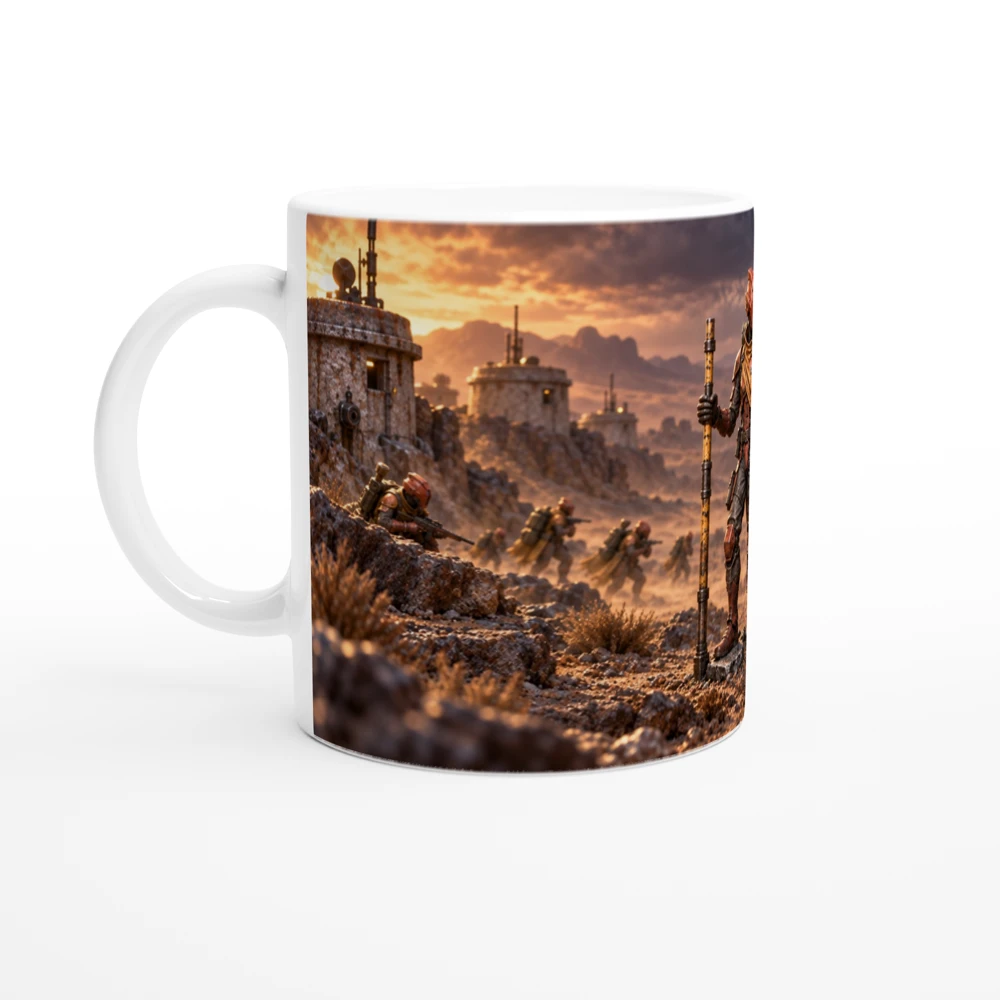
The print area on our 11 oz mug is roughly 200 × 96 mm, wrapped around the outside. That is a letterbox, and it is a curved one: at any moment the person holding it can see maybe a third of it flat-on, with the rest falling away towards the handle on one side and their own palm on the other.
What the shape does to your picture
Three things happen to an image on that band, and knowing them in advance is most of the job.
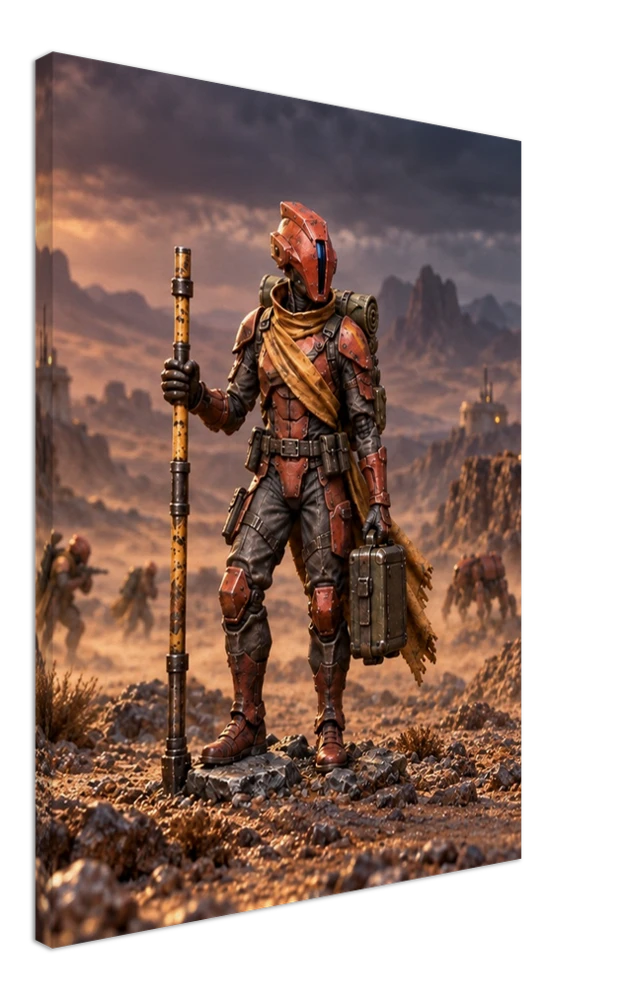
- Height is the scarce dimension. Ninety-six millimetres is shorter than a postcard. A tall composition — a standing figure with sky above and base below — has to shrink until the figure is thumbnail-sized, or be cropped until it is no longer the composition you liked.
- The middle is the part you can count on. Whatever you most want seen belongs centrally, because the edges are either curving away or behind the handle, and which one depends on the hand they hold it in.
- Fine detail loses a fight with a curve. Edge highlights and freehand that read beautifully at A3 are being bent through an arc here and viewed at arm's length over a desk.
Before you print your art on a mug, look at it small
The single most useful test costs nothing. Shrink the image on your screen until it is about eight centimetres tall and step back to arm’s length. That is roughly what the mug will give you, and only about a third of it faces the drinker at any moment. If you can still tell instantly what you are looking at, the crop is right. If you find yourself leaning in, it is not.
Most images fail that test not because they are bad but because they were composed for a different shape. A picture built for a wall has room to breathe around the subject, and every millimetre of that breathing room is wasted on a band 96 mm tall. Tightening the crop is not a compromise here; it is what the format is for.
The crops that work
One subject, close, square-on, against a background that is doing nothing clever. That is the whole answer, and it is boring precisely because it is reliable. A head-and-shoulders crop of a single painted figure is the version people pick up and turn round. A battlefield with eleven models on it becomes a brown stripe.
If the piece you love is a wide scene, the honest move is to print the scene somewhere it fits and put a detail from it on the mug. Cropping in hard on the one element that carries the picture usually produces a better mug than shrinking the whole thing, and it stops the mug competing with the print.
Checking the file before you commit
A mug is forgiving on resolution compared with a wall print, because 200 mm of width at arm's length is not asking much. It is unforgiving on aspect: an image that is much taller than it is wide will be cropped hard whatever you do, so crop it yourself rather than letting the placement decide.
If you want to see the arithmetic behind that, the paper sizes pages work through how pixels, dpi and print size relate; the same division applies here, just to a much smaller and stranger rectangle.
What it costs and what arrives
On washing, we make no dishwasher claim. Wash it by hand and the print stays looking new longer, which holds for anything printed on ceramic. Treat it as the good mug rather than the one that lives in the machine.
When a mug is the wrong object
If the point is to show the work, a mug is a poor showcase — it is held, not looked at, and two thirds of the image is facing away at any moment. Something on a wall does that job far better. The format guide compares paper, canvas, metal and wood against the everyday objects, and it is worth two minutes before you commit an image you care about to a curve.
Where a mug wins is frequency. A print gets looked at properly for a week and then becomes furniture. A mug gets picked up every morning, which is a different and sometimes better kind of present.
Compare the available sizes and prices before ordering. Free UK delivery is included in every price.
Good to know
How big is the printable area on a mug?
About 200 × 96 mm, wrapped around the outside of an 11 oz mug. Only part of it faces the drinker at any one time, which is why central subjects work and edge detail does not.
Can I print a wide battlefield scene on a mug?
You can, and it will read as a stripe. A wide scene loses everything at 96 mm tall. Crop in on one figure or one detail instead, and print the full scene at a size that suits it.
Is a printed mug dishwasher safe?
We do not make that claim. Hand washing keeps a printed mug looking new for longer, which is true of printed mugs generally.